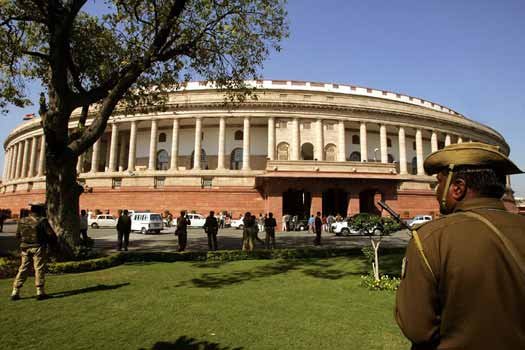

New Delhi, Dec 8: Members in Lok Sabha have come out strongly against the scrapping of National Judicial Appointments Commission (NJAC) Act by the Supreme Court and pitched for accountability of judges.
AIADMK’s K Kamaraj, P Ravindra Babu (TDP) and BJP’s PP Choudhary demanded that the Government should come out with a new Bill for implementing the NJAC law which should also have provision for state judicial appointment commissions.
Observing that the judiciary was under severe stress, Tathagata Satpathy (BJD) said “I am not judging them, but they are judging the House. Decrying the NJAC Act, it is a slap on the face of the people. It is a very sad event”.
Babu said although the Members of Parliament are accountable to the people of India, the judiciary is not accountable to anyone.
“People of the country are supreme. Why should judiciary interfere with us? I would urge government to make amendments. Autonomy without accountability will destroy the very basis of the judiciary,” Babu said.
A Sampath (CPI-M) said the judiciary in India was following the principle of “I am the judge, I am the jury and I am the executioner. You show them (judges) the map, they will show you rules”.
He said “judiciary is hiding behind their words, they are afraid of the people. Judiciary should be made accountable to the people”.
M I Shanavas (Cong) said Parliament had shown unity in passing the NJAC Act. State assemblies also passed it, but still it was dismissed by the judiciary.
BJP’s Choudhary said democracy has three basic pillars– Parliament, Executive and Judiciary. While the earlier two are accountable, judiciary to not accountable to anyone.
To that, Deputy Speaker M Thambidurai remarked: “Judiciary is also accountable to Parliament. Parliament is supreme”.
Choudhary said judiciary is performing two functions — one of judiciary, another of the executive.
The NDA government had in October suffered a setback when a by a five-judge Constitution Bench of the Supreme Court struck down the NJAC Act 2014 seeking to replace the 22-year old collegium system of judges appointing judges and giving a major role to the executive in appointing judges to higher judiciary.