- Annual income of 4000 Tribal households increased nearly three times over three years;
- Nearly 279 tons of CO2 sequestered per hector;
- Biomass increased over 1014 tons in three years;
- 2760 hectors of village forest protected in 84 villages;
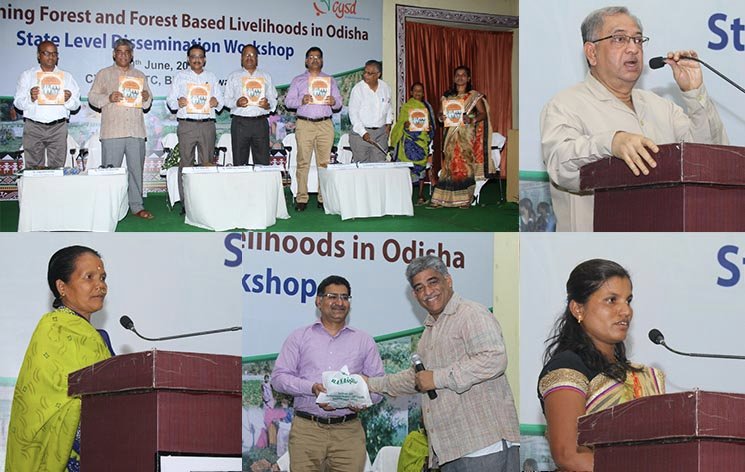
Bhubaneswar, June 29: The project ‘Strengthening Forest and Forest Based Livelihood’, which has been nurturing 4000 forest dependent tribal households (HHs) in Koraput, since 2014, has helped in collectivising the forest dwellers through 261 producer groups under 48 cluster level federations in five block level women producer companies in the district. Along with income enhancement of tribal families the project has also given importance to forest protection and regeneration ”, says Laxmi Khila, chairperson of Sabujima Producer company at Boipariguda block. The women producers across the block aggregate their agriculture, horticulture and non timber forest products (NTFPs) and through the company they formed, they sell those to the higher market with a better price realisation than local traders , she further added. “Likewise other tribal houses in other blocks are also getting benefitted by getting paid better too,” said Pramila Krishna, Chairperson of Maulimaa Women Producers company in Kundra block of Koraput.
The project is being supported by USAID and implemented by CYSD, a state level civil society organization (CSO) focused on mapping of availability of agriculture and NTFP products in 250 villages spread over five Maoist prone blocks of Koraput district. The aggregated products are value added and sold through the collectivization process to the higher markets, bypassing the local traders. The baseline study conducted in 2014 before the inception of the project shows that the average annual income of a tribal family was Rs 19,618, however, in 2017, the average annual income of each HH has gone upto Rs 47,256, nearly about three times. More than 86% of HHs have earned over 30% than previous years’ annual income within three years time.
The tribal women producer companies played the role of local traders by which the ultimate benefit goes to the tribal women. Apart from this the project also focused on forest restoration and regeneration under which 2760 hectors of village forest are protected by 84 tribal villages. Under this, 472 hectors of hinter forest covered in seed dibbling, fuel and fodder and NTFP saplings are planted in 120 hectors and 70 hectors covered with bamboo plantation. “Bamboo is an economic crop for tribal families and also helpful for ecology as one hector of bamboo can sequester 15 tons of carbon dioxide in a year,” said Principal Chief Conservator of Forest in a workshop organized by CYSD here on Friday. Among others R.K. Dey, Additional PCCF, Ministry of Environment and Forest, Bijayaketan Pattnaik, former PCCF, Government of Odisha, Jagadananda, Mentor, CYSD and Prafulla Kumar Sahoo, Chairman, CYSD were presented in this occasion.