
Delhi: November 21:
World Television Day is observed globally on 21 November each year, following a United Nations General Assembly Resolution adopted in 1996. The Day recognizes television as a vital medium in informing, educating, and influencing public opinion, and in fostering communication and global understanding.
In India, where over 230 million television households reach around 900 million viewers, the Day is observed under the aegis of the Ministry of Information and Broadcasting (MIB) and its public broadcasting network, Prasar Bharati. Activities and outreach programmes by Doordarshan and All India Radio highlight television’s enduring role in public service communication, dissemination of development messages, and promotion of national integration.
Television remains one of the most potent platforms for information and entertainment outreach in India, connecting millions of households and contributing significantly to public awareness and participatory governance.
Growth of television in India
Television in India has evolved from a limited experimental service to one of the world’s largest broadcasting networks, reflecting the country’s progress in communication technology, public outreach, and digital innovation. Guided by the Ministry of Information and Broadcasting, India’s television journey mirrors the nation’s socio-economic development—from community education broadcasts in the 1950s to a fully digitised, multi-channel environment today. The following phases trace this transformation, highlighting key policy milestones and technological advancements documented in official records.
Experimental and Foundational Phase (1959–1965)
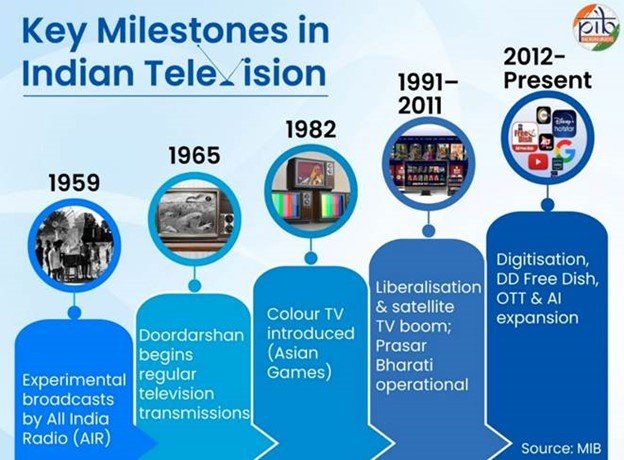
Television broadcasting in India began on an experimental basis on 15 September 1959, initiated by All India Radio (AIR) under the Ministry of Information and Broadcasting (MIB). The service was launched in collaboration with UNESCO to explore television’s role in education and community development. Initially, broadcasts were limited to a small radius around Delhi, with programmes focusing on school education and rural upliftment.
Expansion and Institutionalisation (1965-1982)
Regular daily transmission began in 1965, marking the establishment of Doordarshan as a dedicated television service within All India Radio (AIR). During this period, television rapidly transitioned from a limited experiment into a growing public service medium. New television centres were set up across major cities, including Mumbai (1972), Srinagar, Amritsar, and Calcutta (1973–75), and Chennai (1975), expanding coverage and strengthening the national broadcast infrastructure. Doordarshan emerged as one of the key aspects in the broadcasting landscape in India, reflecting the rapid expansion of television as a national medium during this period.
A landmark development of this era was the Satellite Instructional Television Experiment (SITE) conducted in 1975–76 by ISRO and NASA, one of the world’s largest satellite-based education experiments. Under SITE, NASA’s ATS-6 satellite enabled direct broadcast of educational content to around 2,400 villages across 20 districts in six states, while ISRO provided ground systems and AIR managed programme production. Programmes focused on agriculture, health, family planning, primary education, and teacher training — laying the foundation for satellite-based development communication in India.
Doordarshan expanded its mandate beyond entertainment into news, public service broadcasting, community learning, and educational outreach. The network began structured broadcasts in school education, rural development, and awareness generation, setting the stage for future national initiatives such as UGC’s higher-education telecasts and CEC’s curriculum-based programming.
This period also marked Doordarshan’s growing role in delivering authentic, balanced news and public information across the country, as public broadcasting evolved beyond entertainment into a tool for social development. Regional Doordarshan Kendras strengthened local-language content creation, enabling broader representation of India’s cultural and linguistic diversity. With the expansion of television centres and regional production units, Doordarshan strengthened local-language content creation and broadened cultural representation.
By the early 1980s, the institutional foundations of Indian television were firmly established — a nationwide network, a development-oriented programming ethos, and growing technological capability that would drive the next phase of expansion, including colour broadcasting and national coverage.
Colour Television and National Coverage (1982–1990)
The introduction of colour television in 1982, coinciding with the Asian Games in New Delhi, was a landmark in India’s broadcasting history. This period saw rapid expansion of terrestrial transmitters under Doordarshan, extending reach to rural and remote areas. By 1990, Doordarshan’s network covered nearly 70% of India’s population and 80% of the geographical area. During the 1980s, Doordarshan also expanded the role of its regional broadcasting centres—known as Doordarshan Kendras—which produce and transmit programmes in regional languages, thereby strengthening linguistic and cultural diversity in national broadcasting.
Liberalisation and Satellite Era (1991–2011)
With the economic liberalisation of the early 1990s, India’s television landscape opened to private satellite broadcasters. Early private channels included Star TV (1991), Zee TV (1992) and Sony Entertainment Television (1995), which introduced new formats in entertainment, film, music, and news programming and marked the beginning of a multi-channel satellite television ecosystem.
During this period, Doordarshan expanded and diversified its national and regional network. Channels such as DD National, DD Metro, DD News, DD India, and several DD Kendras (state broadcasting centres operated by Doordarshan) continued to deliver public-service broadcasting and regional-language content, ensuring nationwide access as private networks grew.
India also transitioned to digital satellite broadcasting during this era. A major milestone was the launch of DD Direct Plus in December 2004, India’s first free-to-air Direct-to-Home (DTH) service, which significantly expanded access to television in rural and remote regions.
Digitisation and Modern Broadcasting Phase (2012–Present)
The Government of India implemented Cable TV Digitisation in four phases between 2012 and 2017, under the Cable Television Networks (Regulation) Act, 1995, ensuring improved signal quality and viewer choice. Prasar Bharati’s DD Free Dish, India’s only free-to-air DTH service, emerged as a major vehicle for digital inclusion, reaching nearly 50 million households as of 2024. Today, India’s vast television network serves hundreds of millions of viewers nationwide, making television the country’s most accessible mass communication platform and connecting urban and rural audiences alike.
Viewership and Socio-Economic Impact
Television remains the most widely accessed medium in India, with an intense penetration of satellite and broadcast channels. As of 31 March 2025, the Ministry of Information and Broadcasting (MIB) had permitted 918 private satellite TV channels (for uplinking, downlinking or both) in India. Out of these, 908 channels were available for downlinking in India, of which 333 were pay TV channels (232 SD + 101 HD).
SD channels provide video at lower resolution and bandwidth. In comparison, HD channels offer significantly higher picture clarity and detail due to higher resolution, enhancing the viewing experience, especially on larger screens. The growth in channel numbers from 821 in 2014 to 918 in 2025 underscores television’s continued importance as a cultural and informational medium across linguistic regions.
Television also has significant socio-economic impacts: it employs content creation, broadcasting operations, and regulatory compliance; supports livelihoods in production and distribution; and enables access to education, health, and government schemes for rural and semi-urban populations. Television’s extensive reach, linguistic diversity, and regulatory oversight underline its continuing importance as both a cultural and economic driver in India’s media landscape.
India’s television ecosystem has entered a new era of digital transformation—driven by technological innovation, multilingual content, and inclusive access. Modern broadcasting advancements, such as high-definition and satellite expansion, alongside emerging AI-enabled tools, are already enabling regional-language content creation, real-time subtitling, and interactive programming. These developments ensure television continues to be a truly inclusive medium—bridging linguistic, cultural, and digital divides across the nation.
Supported by government-led initiatives in digital infrastructure, public service broadcasting, and content innovation, television is evolving from a one-way communication channel into a participatory platform that reflects India’s diverse voices. From its modest beginnings in 1959 to its role in connecting over 900 million viewers today, the medium stands as both a mirror and a messenger of India’s progress. It continues to promote awareness, foster inclusion, and shape a connected, informed, and empowered India, reinforcing its enduring role as a cornerstone of national communication.
Source: PIB