
Bhubaneswar, Jan 22: Internationally known physicist, Prof. Jogesh Chandra Pati, whose path-breaking contribution towards the theory of “grand unification” threw up new fundamental ideas in theoretical physics, on Tuesday said it had answers crucial to the origin of life.
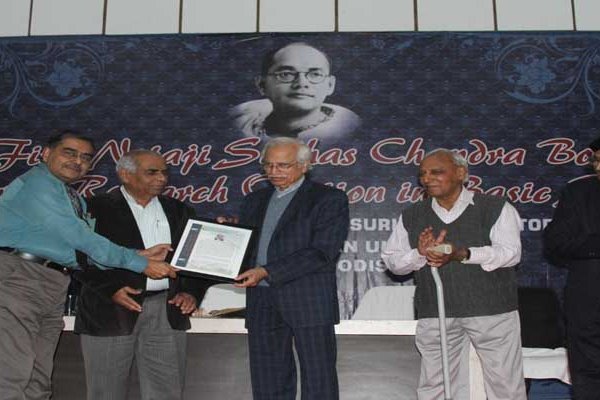
“This theory shed light on elusive properties of the feeblest and the lightest known massive particles—the neutrinos— and the origin of matter-antimatter asymmetry of the universe, which was crucial to the origin of life and our own existence,” Prof. Pati said while delivering the first ever Netaji Subhas Chandra Bose Memorial Research Oration in Basic Sciences at the SOA University.
Perhaps the most profound consequence of grand unification was the prediction that the lightest observed nuclear particle—the proton—which was known to be extraordinarily stable, must ultimately decay, Prof. Pati said.
Pati, presently Professor of Physics at the Stanford National Linear Accelerator Centre, Stanford University, USA, spoke on the subject “Unity in Particle Physics: A Quest for Beauty and Simplicity.”
The oration, which will be an annual event to be delivered by an internationally renowned Indian scientist, has been introduced by the SOA University this year.
Prof. (Dr.) Amit Banerjee, Vice-Chancellor of SOA University, presided over the program. Prof. Minaketan Parida, Director of the Centre of Excellence for Theoretical and Mathematical Sciences (CETMS) run by the SOA University, also spoke.
Former Director of IIT, Kharagpur and presently Chairman of the Advisory Council of SOA University Damodar Acharya said the oration had been named after Netaji keeping in view the patriot’s dream of an independent India where research needed to play a dominant role in national reconstruction encompassing the fields of agriculture, industry and scientific growth.
While neutrino masses predicted by his theory had been proved by experiments, worldwide efforts were underway to detect proton decay including at research stations in South Dakota in USA and Japan. “India was also expected to play an important role in this research,” Prof. Pati said adding “discovery of proton decay will constitute a landmark in the history of physics.”
Prof. Pati, who teamed up with Pakistan’s Prof. Abdus Salam, had suggested the revolutionary concept of unification of fundamental forces— the nuclear, electromagnetic and the weak-radioactive.
Prof. Pati said that progress in physics, of a fundamental nature, had often occurred by finding connections between diverse phenomena, in short by realizing a certain unity in diversity.
“A theoretical formulation based upon beauty and simplicity in the underlying laws of nature is sometimes guided by experiments and sometimes just pure thought. This has invariably been the guiding principle very often unraveling clues to the unknown laws of nature,” he said.
The Vice-Chancellor Prof. Banerjee presented a citation to Prof. Pati while Prof. P.K.Sahu, Dean of the Institute of Technical Education and Research (ITER), faculty of engineering of SOAU, felicitated him.