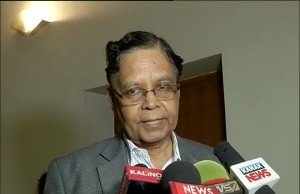

Bhubaneswar, Jan 10: Niti Aayog Vice Chairman Arvind Pangariya on Saturday said that there was a rapid shift of workforce from agriculture to industry in fast growing nations which had led to a sharp reduction in poverty in fast growing economies.
Speaking at the annual convention ‘Foresight 2016’ of a local television channel, Pangariya said rapid growth in India was achieved very late as compared to other countries like Korea, Singapore, Taiwan.
“Upto 80% of India’s workforce is in small & medium industries and this trend has to change,” he added.
Citing the example of China’s growth rate, he emphasized the large scale industries in taking the economy forward.
“When large firms are absent, the small and medium firms are very low productivity firms”, he added.
Pangariya said workers are moving out of agriculture to manufacturing units at high wage rate and that is why the manufacturing units grew rapidly in China.
Speaking at the event, journalist Rajdeep Sardesai said that the private life of an individual should not decide his nationalism.
“The issue started with the killing of an innocent man on the allegation of a rumour that he had stored beef in his house. Is that the kind that the India we want? Do you want a country which will decide what a person does inside his kitchen is going to decide his nationalism?” he asked.
He said, “In incidents like this shocking news, perfectly reasonable, rational and decent human beings get caught in this kind of shrill polarised debate on intolerance. That is the kind of story India does not need to showcase for the rest of the world”.
Discussing about politics in the country, Rajdeep said the monsoon session of the Parliament was washed out because of Lalit Modi. While the Congress and the BJP members were clamouring to bring back Lalit Modi to India, the latter was having the last laugh while enjoying his holiday in Montenegro.
“Legislation, not agitation, is the primary job of Parliamentarians. Is this the kind of politics you want?” he asked.
Discussing Madhya Pradesh’s much discussed Vyapam scam, he said Congress says Madhya Pradesh chief minister Shivraj Singh Chouhan is the prime accused. The fact is Vyapam also existed during the reign of Digvijay Singh as the chief minister who is from the Congress.
“It is typical that both Congress and BJP will blame each other while both them have to answer for it. On the other hand, the innocents have lost their lives in the process because they bribed and paid money with the hope they would get a job”, Rajdeep said.
Criticising the BJP government’s “Achhe Din” slogan, he said the recruitment of peons in Chhattisgarh bears ample testimony to the hollow promises of the Modi government.
“The Chhattisgarh government had advertised for recruitment of 30 peons last year for which over 75,000 candidates, including some qualified engineers, had applied. Is this the “Achhe Din” the government is talking about? It is easy to sit in San Fransisco and talk to Mark Zuckerburg as some of our political leaders want to do,” Rajdeep pointed out.
He, however, said the biggest story of this year is the story of agrarian distress or what is happening in rural India today. Citing the plight of the farmers in Maharashtra, he said while around 3,000 farmers committed suicide in the last 12 months, the veteran leader of the state who was the chief minister and who is in active politics for nearly four decades, Sharad Pawar celebrated his 75 birthday like a maharaja.
Talking about the state of journalism in India, Rajdeep said “Our national headlines these days are on what is happening in Delhi and Mumbai and not even in Chennai, even when there was a flood like condition in 2015.”
In a state like Jharkhan,d there are lots of serious conflicts and issues for debate, but none of them are finding place in the national media, he said.
On the future of journalism, he said the future is strong in regional media and regional channels because in Delhi we are practising doorstep journalism.
Union minister of state for Finance Jayant Sinha said as part of its economic policies, has laid emphasis on the sustainable growth of eastern India.
“What we are trying to do as far as India’s economic growth is concerned is to build India’s productive capacity which means for is that eastern India is to raise its productive capacity as well,” he said.
Stating that productive capacity includes both hard and soft assets, the Union minster said it is a very different approach from the previous UPA government which was much more inclined to demand side and consumption oriented.
“When we talk about productive capacity, we are talking more about the supply side and investment driven growth. That’s what we mean about productive capacity which is the hard assets and soft assets which are of great importance to eastern India. The hard assets are roads, bridges, highways, ports, educational infrastructures. The soft assets are of great importance for eastern India as it includes skills and employability of our young people which means the strength of our economic institutions, innovation and entrepreneurial eco system of the country. It is therefore, a supply side and investment view of the world and not a demand side and consumption oriented view of the world. If we build productive capacity in India, especially in eastern India, then we have the ability for sustained growth over a long period of time which is vitally important for us”, he said.
Talking about the growth rate in the eastern Indian States, Sinha said Odisha and Jharkhand have witnessed 8 percent growth and West Bengal and the north-western have posted 7-8 percent growth which is not enough to just grow at this rate for two, three or four years.
“For eastern India, it is vitally important that we should grow at least at 8-10 percent for decades. Only then, we will be able to develop the full potential of Eastern India,” he observed.
“Talking about the Smart City programme of the Centre, Sinha said Bhubaneswar and other cities, which were included under the programme, are going to get substantial resources over the next few years so that they can become growth magnet.
“That’s really a vision for the Eastern India. If we will be able build to the productive capacity of eastern India and build the productivity capacity, we will be able to sustain growth that is important for this region.”
“Eastern India is rich in resources, in talent, in temperate weather and agricultural potentials. But the people are poor. It is all our collective responsibility to work together for the people of the eastern India so that they can get the quality of life they deserve,” he said.